By Emma Nicolas
In our Rethinking the Farm Bill blog series, we bring our 2026 Farm Bill policy priorities to life with stories from farmers and ranchers across the country who are navigating a food system increasingly controlled by a handful of powerful corporations.
It’s no accident that America’s independent farmers are struggling—it’s the result of a system intentionally shaped to benefit the largest corporations. Decades of lax antitrust enforcement and policies that favor industrial agriculture have enabled a handful of dominant companies to control our food system, slashing competition and pushing independent farmers out of business.
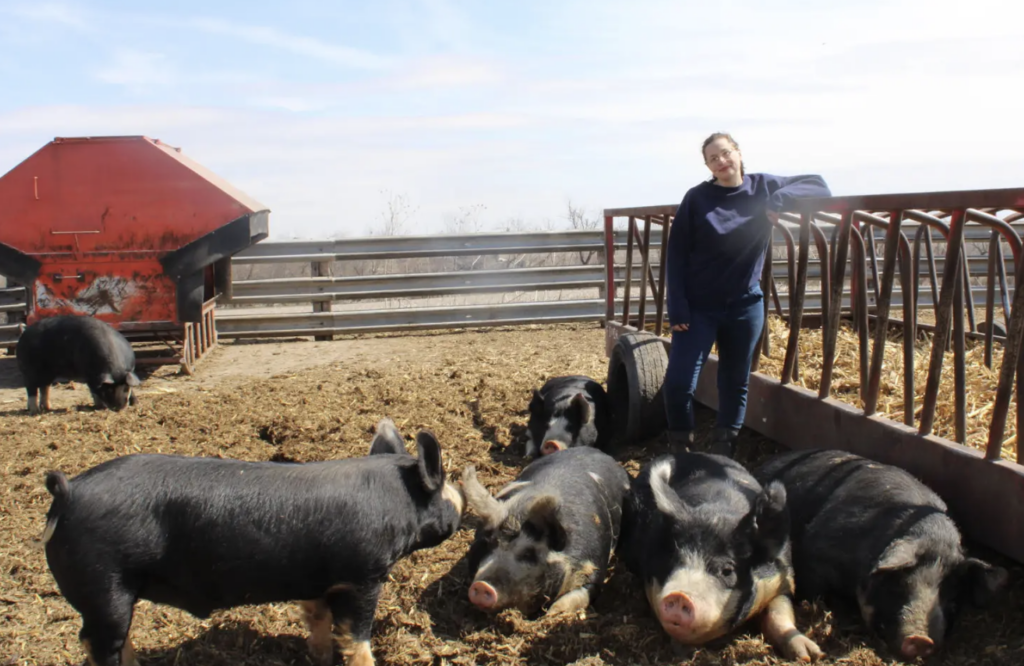
We sat down with Anna Pesek, co-owner of Over the Moon Farm in eastern Iowa, to discuss what it’s like as an independent farmer working in a system designed for—and by— corporate agriculture. Anna’s story reveals what it takes to operate outside that system and why we must urgently restore competition.
“It is wild how hard it is to raise and market 100 pigs,” said Anna, who raises crate-free pork and runs a direct-to-consumer meat company with her wife, Shae. “We’ve had to just build our own supply chain and our own markets.”
There’s a chance to shift the food and farm system status quo with the 2026 Farm Bill, but it depends on whether Congress chooses to support independent farmers like Anna or corporate lobbyists.
“The possibility that the farm bill is passed as a handout to an already concentrated industry like the Big Four meatpackers… is very concerning, and that is a possibility,” Anna said.
A System Built for Corporations
The pork, poultry, and beef industries are each dominated by just four corporations that control nearly every step of the system.
“They’re controlling the production of that animal. They’re controlling the processing, so the butchering of that animal. They’re controlling the selling of that animal. They’re controlling the transportation that happens in between. They’re controlling the workforce,” Anna said.
Anna explained that this level of control gives these corporations outsized power, “over what farmers grow, how they grow it, and what consumers eat.”
As a result, independent farmers struggle to enter the market because they face major barriers in getting their products processed and finding reliable buyers. That leaves them with few options other than working for one of these corporations. Many meat and poultry farmers operate under contracts where the company dictates how the farm is run—often requiring large confinement buildings—while the farmer takes on most of the financial risk.
“There’s very few options between 100 pigs and 4,000 pigs,” Anna said. “Your options really are to have a confinement, where you have a contract, or to be existing in this totally alternative world.”
Anna and Shae chose the latter when they started farming on Shae’s multigenerational farm, but that choice comes with steep challenges.
“We’ve built a business that is this viable alternative, but the barriers are still so, so high, because we’re operating within an economic and political landscape where we have an incredibly consolidated animal protein supply chain,” Anna said.
Anna and Shae run into those barriers everywhere, from the bank to the grocery store. Their access to capital is limited because there are not many other examples of successful businesses like theirs.
“It makes it hard to grow and hard to expand,” she explained.
On the consumer side, prices are distorted by the lower cost of products from corporate, industrial operations compared to the hogs the Peseks raise, which are priced to reflect the full cost of production. They raise the pigs, slaughter them, drive them two hours to a processor, drive the product back to their farm to inventory, and then ship and deliver orders once a week.
“It costs me a lot more to produce, and there’s a lot of labor that goes in. And we’re not externalizing costs onto our community, and people don’t see that,” she said.
Externalized costs are how dominant meatpackers keep their prices artificially low, because polluted air and water, taxpayer subsidies, and public health impacts don’t show up in the price tag. The result is a system that rewards the lowest sticker price—not the true cost—putting independent farmers at a constant disadvantage.
But these are exactly the kinds of barriers the farm bill can address, from improving credit access to curbing anticompetitive practices.
Creating a Different Model
In the absence of competitive markets, farmers like Anna are forced to build alternatives from the ground up. At Over the Moon Farm, Anna and Shae raise farrow to finish Berkshire pigs without confinement or crates. They also raise pastured poultry, chicken, and turkeys, and then aggregate other meat, particularly from other beginning farmers in Iowa, and sell it all directly to consumers across Iowa and the country.
Owning and running a farm and a meat company is no small feat, but over the last few years, Anna and Shae have begun to build something bigger than themselves.
“[We] started thinking about Over the Moon meat as a potential national brand that could offer fair market opportunities for other producers, and could not just support us, but hopefully support the building of supply chains that are better for consumers, better for other farmers, better for animals,” Anna said.
And they see it not only as the sole option, but also as the best one for their community. Anna and Shae see building back small and mid-scale livestock production in Iowa as a critical tool to revitalize their hollowed-out rural community. They spend their money with local businesses, rely on the local veterinarian, and also provide a high-quality, nutrient-dense product to their community.
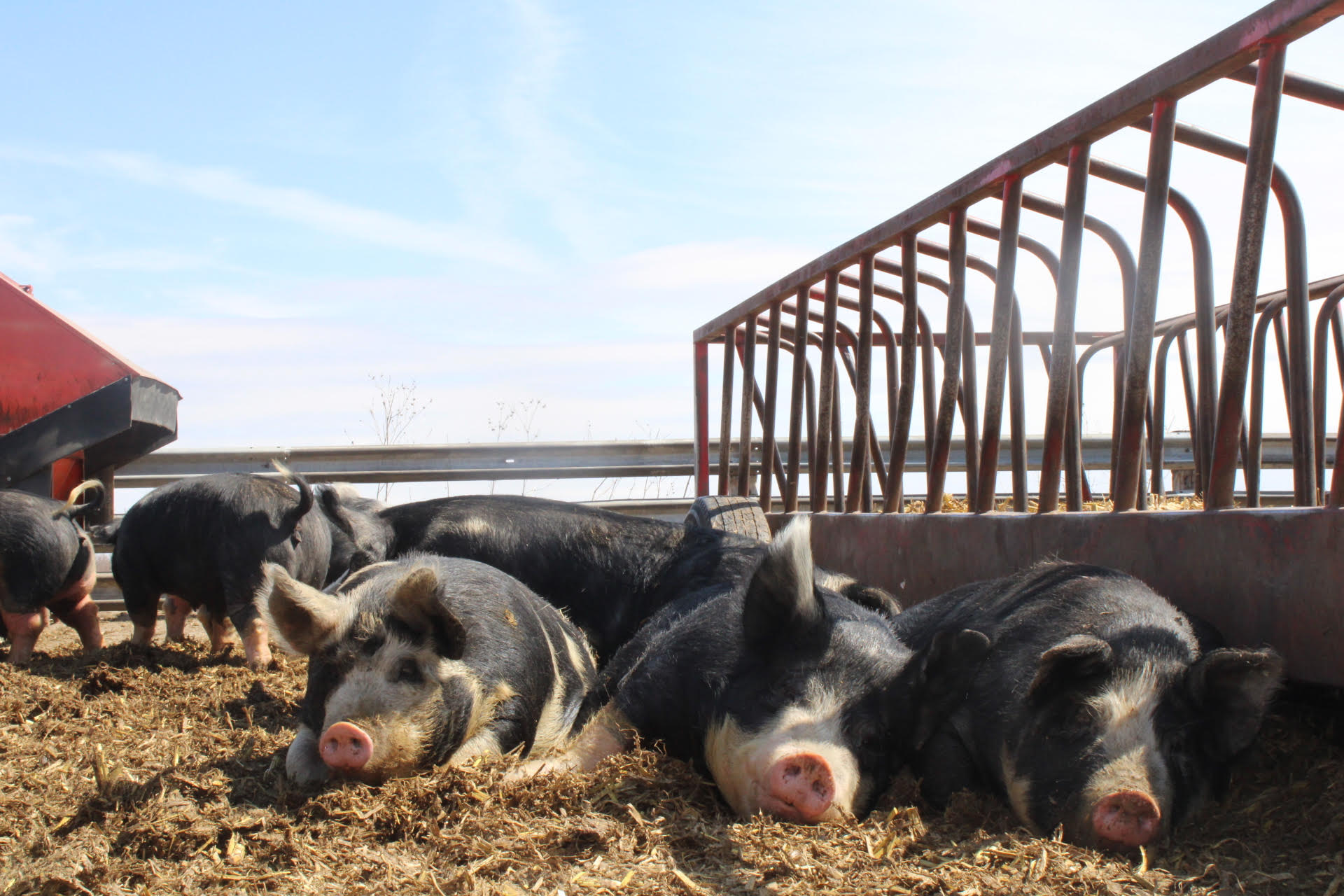
Anna and Shae’s Berkshire pigs
“We’re invested in this place. We want to see it thrive. I am drinking the water, breathing the air. I want there to be a future here, and so I think that is also a key part of having small and mid-scale businesses too,” Anna said. “Our home is tied to it.”
What's at Risk
The challenges Anna and Shae face are not unique. They are the direct result of a highly consolidated system that is squeezing farmers today and limiting who can farm tomorrow.
Strengthening competition is key not only to addressing the crises facing farmers and rural communities, but also to protecting America’s food security. Anna said she hopes Congress recognizes that the current system is only serving corporations.
“It’s not good for anyone except for their profits and their shareholders’ profit,” Anna said. “I think that is a bipartisan position… that a lack of competition is not good market practice for literally anyone involved.”
That same consolidation is also reshaping land ownership, making it harder for the next generation to get started. As farmland is concentrated in fewer hands, prices rise, and access becomes more limited for independent and beginning farmers. This comes at a critical moment, as the average farmer is 58 years old, and a large amount of farmland is expected to change hands in the coming years.
Anna, who is 30, said they were lucky to farm on a multigenerational farm, but starting out is still incredibly difficult.
“It’s nearly impossible to get started in anything, because no matter what, you’re dealing with high land costs, high equipment costs, increased consolidation of land,” she said. “There’s just very few options to even buy to get started.”
As Farm Action’s farm bill platform lays out, addressing these challenges will require stronger oversight of the market abuses that allow this level of concentration to persist—from investigating anticompetitive behavior in the meat and poultry industries to examining competition across key input markets.
“I really want to see Congress take seriously that that level of concentration is a crisis and should be addressed,” Anna said.
Why This Moment Matters
Debate is underway on the 2026 Farm Bill, which will determine the future of our food system and who it benefits—corporations or farmers.
“It feels like, to me, everything is at stake,” Anna said. “It’s the question of how we’re going to choose to feed people, because the farm bill is a massive tool for investment.”
Now is the time to make your voice heard in support of independent farmers like Anna.
TELL CONGRESS: PROTECT OUR FOOD AND FARMERS
Coming up next in our Rethinking the Farm Bill series, we’ll tackle another of our seven priorities for farm bill reform: Rebuilding local and regional supply chains—a look at how we can support farmers closer to home.