

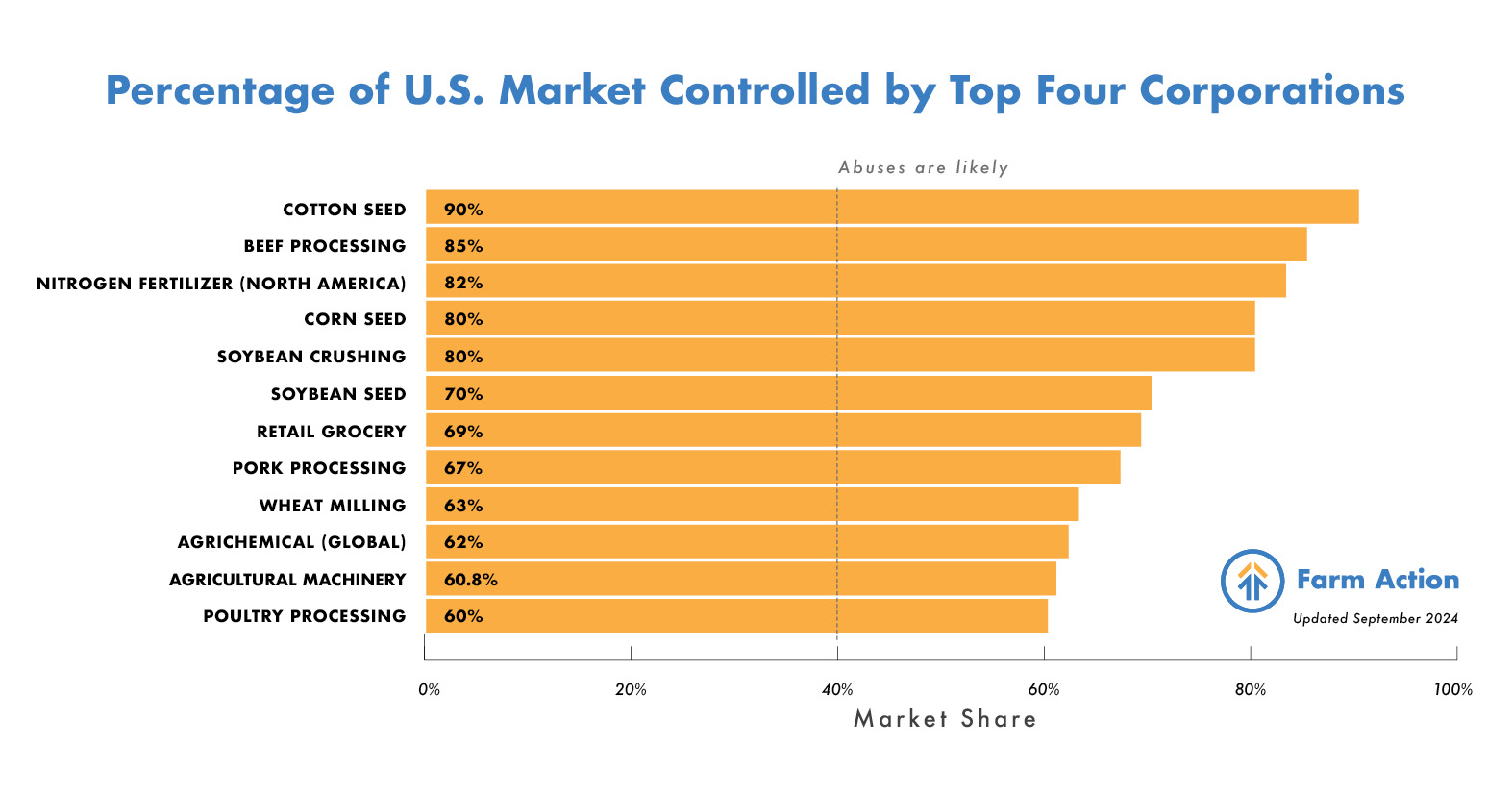
Throughout The Food Monopoly Files series, we have traced how corporate concentration reshaped nearly every link in America’s food system—from the seeds farmers plant, to the equipment they rely on, to the grocery stores where families buy food. We’ve exposed how consolidation followed a deliberate corporate playbook that reshaped markets, weakened competition, and shifted wealth away from farmers, workers, and rural communities.
But history makes one thing clear: Monopoly power in agriculture is not inevitable, and it can be challenged. As we lay out in this blog, we’ve learned key lessons from our past monopoly crisis in the U.S. to help chart our path forward:
- When a few corporations control the market, everyone else pays the price.
- Real competition depends on fair rules, and real consequences when companies break them.
- Corporations shouldn’t be allowed to operate in the dark.
- Strong local food economies make the whole country stronger.
Understanding how earlier generations confronted corporate power offers a roadmap for rebuilding a fair, competitive, and resilient food system today.
Lessons From America’s First Monopoly Crisis
At the turn of the 20th century, Americans faced a crisis much like the one we face today. A handful of corporations, including the “Meat Trust,” railroad monopolies, and grain trading giants, dominated agricultural markets.
Public outrage grew as farmers, ranchers, labor groups, and consumers recognized that concentrated market power stacked the economy in favor of big corporations and enabled them to dodge accountability. Policymakers responded with reforms to restore competition and curb corporate abuse.
They began with the Sherman Antitrust Act of 1890, which established federal authority to break up monopolies and prohibit anti-competitive behavior. Congress strengthened these rules through the Clayton Antitrust Act of 1914, banning tactics big companies used to shut out rivals—like giving special deals to certain buyers or locking buyers into exclusive contracts. Lawmakers then turned directly to abuses in livestock markets by passing the Packers and Stockyards Act of 1921, which confronted meatpacking monopolies that manipulated prices and exploited producers.
Together, these laws reshaped agricultural markets for decades, helping preserve competition and protect farmers and consumers.
What Changed, And Why It Matters
Beginning in the 1980s, the federal government pulled back from aggressively enforcing competition laws. Regulators narrowed antitrust enforcement and focused mostly on short-term ‘efficiency’—like keeping prices low in the moment—while overlooking how mergers would concentrate power into a few hands. Over time, that power let corporations squeeze producers and raise prices.
This shift allowed corporations to merge on an unprecedented scale and take over more steps along supply chains. Corporate buyers gained leverage over farmers and workers, while dominant suppliers gained control over farming inputs and technology. Over time, consolidation reshaped the entire food economy, concentrating power into fewer hands while weakening the safeguards that once balanced markets.
The consequences are now visible across rural America and the broader food system: fewer farms, fragile supply chains, reduced worker protections, and rising food prices despite record corporate profits.
But just as history shows how monopoly power expanded, it also shows that it can be reversed.
Paths Toward Beating Monopolies
Rebuilding fairness in agriculture does not require inventing entirely new solutions. It requires modernizing and enforcing principles that worked once before.
Stronger Antitrust Enforcement
Rigorous merger review and enforcement of laws designed to stop companies from taking over the market would help restore competition across processing, input supply, and retail sectors. Breaking up or regulating dominant firms creates space for independent producers and regional businesses to re-enter the market.
Making the Market Fair for Farmers and Workers
Policies that strengthen contract fairness, prohibit companies from taking advantage of farmers, and protect worker safety can rebalance negotiating power throughout supply chains. Ensuring that producers and workers can compete on fair terms is essential to rebuilding rural economic stability.
Rebuilding Local and Regional Food Systems
Investment in independent processing, storage, transportation, and distribution networks can reduce reliance on a handful of dominant corporations. Having more options in supply chains improves market access for farmers while making the system stronger during disruptions.
Strengthening Oversight and Transparency
Greater transparency in pricing, corporate ownership, and market activity can expose anti-competitive behavior and help government agencies, policymakers, producers, and consumers make informed decisions.
Supporting Independent Producers and Local Food
Public investment and government food procurement reforms would expand markets for independent farmers while strengthening local food economies and improving consumer access to nutritious food.
A Future Still Within Reach
The challenges facing today’s food system are serious, but they are not permanent nor insurmountable. Policymakers have multiple tools at their disposal—including antitrust enforcement by federal agencies and opportunities in the upcoming farm bill—to apply lessons from history and shape a fairer, more resilient food system.
The question is not whether America can build a more competitive food system—it is whether we choose to.
This post, like the rest of our Food Monopoly Files series, draws from Kings Over the Necessaries of Life, our landmark investigation into how monopoly power reshaped U.S. agriculture. Understanding how monopoly power operates is the first step toward dismantling it—and toward building a food system that works for farmers, workers, communities, and consumers alike.