
Throughout The Food Monopoly Files series, we have exposed how monopoly power has taken hold across nearly every part of our food system—from meatpacking, to inputs, to retail.
But the consequences of this concentration of power over America’s food system are measured in human lives, not just market share. Behind every statistic about consolidation is a farmer pushed deeper into debt, a worker facing unsafe conditions, or a rural resident losing their economic security.
The human cost of monopoly power is not incidental. It is a predictable outcome of a system designed to concentrate control and shift risk downward. In our last post, we laid out the corporate playbook that engineered today’s food monopolies. Now, we’re focusing on what that playbook means for the people forced to live under it.
Farmers: Locked In, Priced Down, and Pushed Out
For farmers, consolidation has fundamentally changed what it means to make a living in agriculture. As markets narrowed, farmers lost bargaining power—not because they lacked skill or efficiency, but because they had fewer buyers, suppliers, and choices.
In livestock and poultry, contract growing has replaced open markets. Poultry farmers are often bound to a single company that controls the animals, feed, and production specifications. In this system, farmers shoulder the debt, build the infrastructure, and absorb the risk—while corporations retain the power to cut pay, terminate contracts, or shift production with little notice. Speaking out can mean retaliation. Walking away can mean financial ruin.
In crop production, patented seeds and bundled chemical systems have stripped farmers of the autonomy that once defined farming itself. Seed saving, long a cornerstone of agricultural independence, has been replaced by licensing agreements that dictate how seeds may be used, where they can be planted, and what farmers are prohibited from doing with them—from replanting and breeding to independent research. As consolidation accelerated, seed prices rose, choices shrank, and farmers were locked into systems without control.
The result is a farm economy where farmers are producing more but earning less, as profits are siphoned off by powerful corporations that control both the inputs farmers buy and the markets they sell into. Even as consumers pay more for groceries, farmers receive less than 16 cents of every dollar consumers spend on food at the grocery store.
Workers: Dangerous Jobs and Insecure Livelihoods
For workers, consolidation has meant fewer employers, more dangerous conditions, and less power to push back.
Meatpacking remains one of the most hazardous jobs in the country, with high rates of injury and long-term disability from repetitive, high-speed line work. In an industry dominated by a handful of corporations, workers have limited options if conditions become unsafe or wages stagnate because there are no competitors. Recent antitrust litigation highlights this power imbalance: Agri-Stats, an agricultural data firm, agreed to settle a federal class action alleging it helped major meat processors coordinate to suppress wages across plants nationwide.
Tyson Foods’ decision to close its Nebraska beef processing plant underscores how vulnerable workers become in a consolidated system. When a dominant employer shuts down a facility, workers often have nowhere comparable to go—especially in rural communities where that plant may be the largest or only major employer. The closure displaced hundreds of workers, not because the workers did anything wrong, but because corporate consolidation allows companies to shift production, maximize profits, and abandon communities with little consequence.
In a more competitive market, workers could seek better conditions or wages from rival employers. Under our consolidated system, they are treated as interchangeable inputs—absorbing the economic shock of corporate decisions made far from the communities they upend.
Rural Communities: Hollowed Out by Corporate Control
In a thriving rural economy, farmers buy inputs locally, bank at nearby institutions, hire local workers, and send their children to local schools. But large agribusinesses often bypass these local connections, with cascading consequences for the community.
As independent processors, suppliers, and locally owned businesses disappear, rural communities lose far more than jobs. They lose tax bases, economic resilience, and the ability to shape their own futures. Corporate consolidation replaces locally rooted enterprises with absentee ownership, centralized decision-making, and profits extracted far from the places where food is produced.
Industrial agribusiness has long claimed its presence brings prosperity to rural America. In practice, it creates dependence. Farmers have fewer places to sell, retailers have fewer places to source from, and a single corporation gains the power to dictate prices and contract terms. Wealth that once circulated locally is extracted upward, while risk and debt remain embedded in the community.
The consequences ripple outward. Property values decline near industrial facilities, and residents leave in search of opportunity. The resulting shrinking tax bases struggle to fund schools, hospitals, and critical infrastructure.
What remains is a system that depends on rural places for land, labor, and resources, while steadily draining them of wealth, autonomy, and voice.
Consumers: Paying More for Less Choice
When markets concentrate, consumers feel it in their wallets and in the resilience of the food system itself.
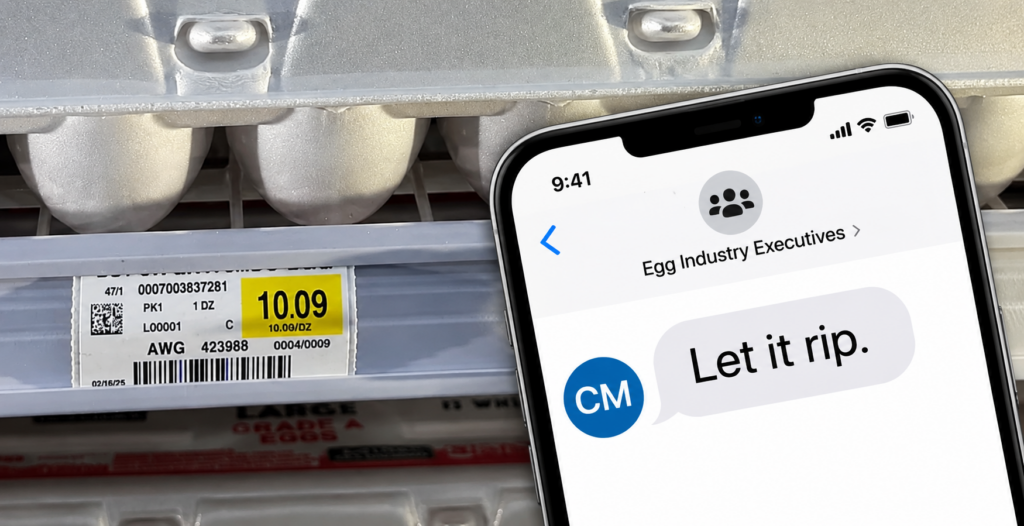
Consolidation at every stage of the food chain—from processing to retail—gives dominant firms the power to set prices with little fear of competition. With just a handful of companies controlling processing, distribution, and retail, corporations can raise prices across multiple links in the chain while presenting it as inflation or supply chain issues, obscuring the role that monopoly power plays in shaping food costs.
In grocery retail alone, four giants—Walmart, Kroger, Costco, and Albertsons—control nearly 70% of the U.S. market. These megaretailers use their scale to demand low prices from suppliers, who then pass those costs onto other competing retailers, who often can’t absorb the cost. As independent and regional stores are pushed out, consumers are left with fewer places to shop, and the remaining giants gain the power to set prices and limit choice with little risk of losing market share.
At the same time, consolidation reduces the food system’s resilience. When a few firms control most processing capacity, disruptions ripple faster and hit harder. For example, when a Tyson beef processing plant in Holcomb, Kansas—which was responsible for five to six percent of beef processed in the U.S.—caught fire in 2019, it caused market panic and price spikes.
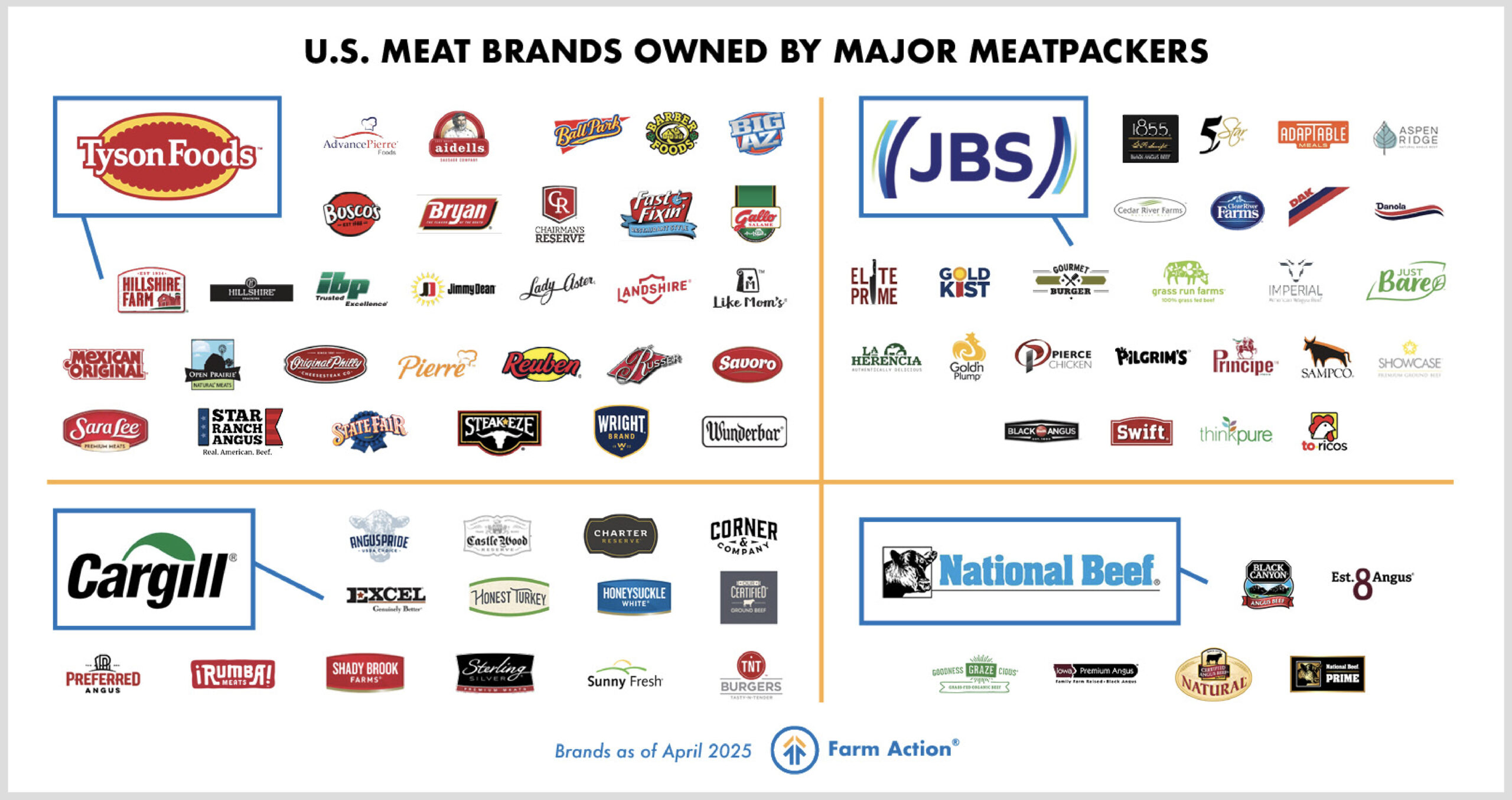
Consolidation also reduces choice on store shelves. Many products sold under different brands are ultimately owned by the same corporations, so consumers face the illusion of variety while real competition evaporates. In a healthy, competitive market, multiple companies would compete for customers by offering better prices, higher quality, and diverse products. Under our highly consolidated system, corporate market power instead enables firms to protect profits at the expense of consumers, with less incentive to innovate or expand choice.
Harm by Design
These outcomes are not accidental side effects. They are the logical result of a system that prioritizes scale and shareholder returns over fairness, resilience, and human well-being.
For decades, policymakers were warned. Farmers testified. Workers organized. Communities sounded the alarm. But as antitrust enforcement weakened and corporate influence deepened, harm was normalized and treated as collateral damage rather than a policy failure.
Understanding the human cost of consolidation makes one thing clear: Monopoly power is not abstract. It is lived.
This post, like the rest of our Food Monopoly Files series, draws from Kings Over the Necessaries of Life, our landmark investigation into how monopoly power reshaped U.S. agriculture. In the next post, we’ll turn to what it will take to rebuild fair markets, restore competition, and put farmers, workers, and communities back at the center of our food system.