By Angela Huffman
Avian flu hit the U.S. egg industry in early 2022. As egg prices soared, Americans were told reduced supply was to blame.
But according to a federal antitrust complaint, major egg companies were working together to push prices higher. The Department of Justice (DOJ) says Cal-Maine Foods, Hickman’s Egg Ranch, and Versova illegally coordinated their buying and selling to manipulate egg prices across the country.
At the center of the alleged scheme was Urner Barry, which publishes egg-price benchmarks that help determine what grocery stores, restaurants, and other businesses pay for eggs.
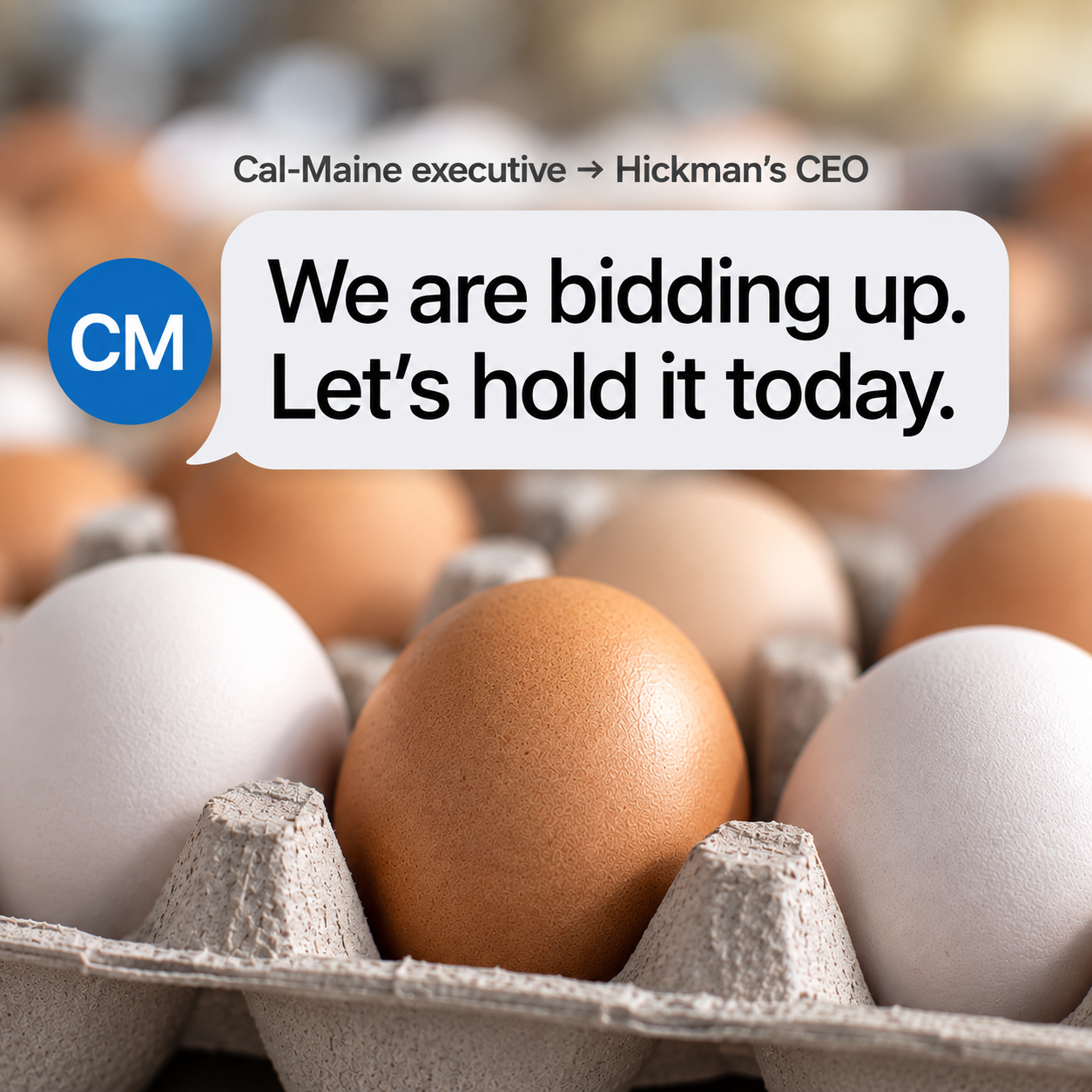
On October 14, 2022, a Cal-Maine executive texted the CEO of Hickman’s Egg Ranch: “We are bidding up. Let’s hold it today.”
The two companies then placed more than half of all the bids on an egg trading exchange. The DOJ says they were trying to keep the Urner Barry price from falling, and they succeeded. A Cal-Maine executive texted Hickman’s CEO again: “No change.”
The DOJ says this was part of a price-fixing scheme that lasted nearly three years, from June 2022 through March 2025. The DOJ’s complaint lays out the texts, emails, phone calls, bids, and trades behind the alleged scheme.
Now the DOJ wants to settle the case. Farm Action believes the proposed settlements fall far short of the seriousness of those allegations.
The DOJ is accepting public comments through October 17. Tell them price fixing needs real consequences.
“Early and often”
By December 2022, the messages were even more brazen. On December 19, executives from Cal-Maine, Versova, and Hickman’s had one of their regular calls about the Urner Barry benchmark. Later that day, Hickman’s CEO emailed the group, “Need to push the spread into the northwest.”
Urner Barry’s market reporters watch egg sales and bids to decide where to set its daily prices. A Versova executive said his company would place more bids the next day. Hickman’s CEO replied that if several companies all started bidding, “the market reporters will have to address.” Urner Barry raised its benchmark that day.
The next morning, Hickman’s CEO told the group to post “strong bids, early and often.” He explained why: “The market reporters don’t get in for another hour, so it will be good for them to see diverse bidding upon logging on.”
In other words, high bids from several companies could make it look like buyers were willing to pay more for eggs.
Then he sent another message: “Hurry.”
He wrote that there were 16 bids on the exchange, and 15 belonged to Hickman’s.
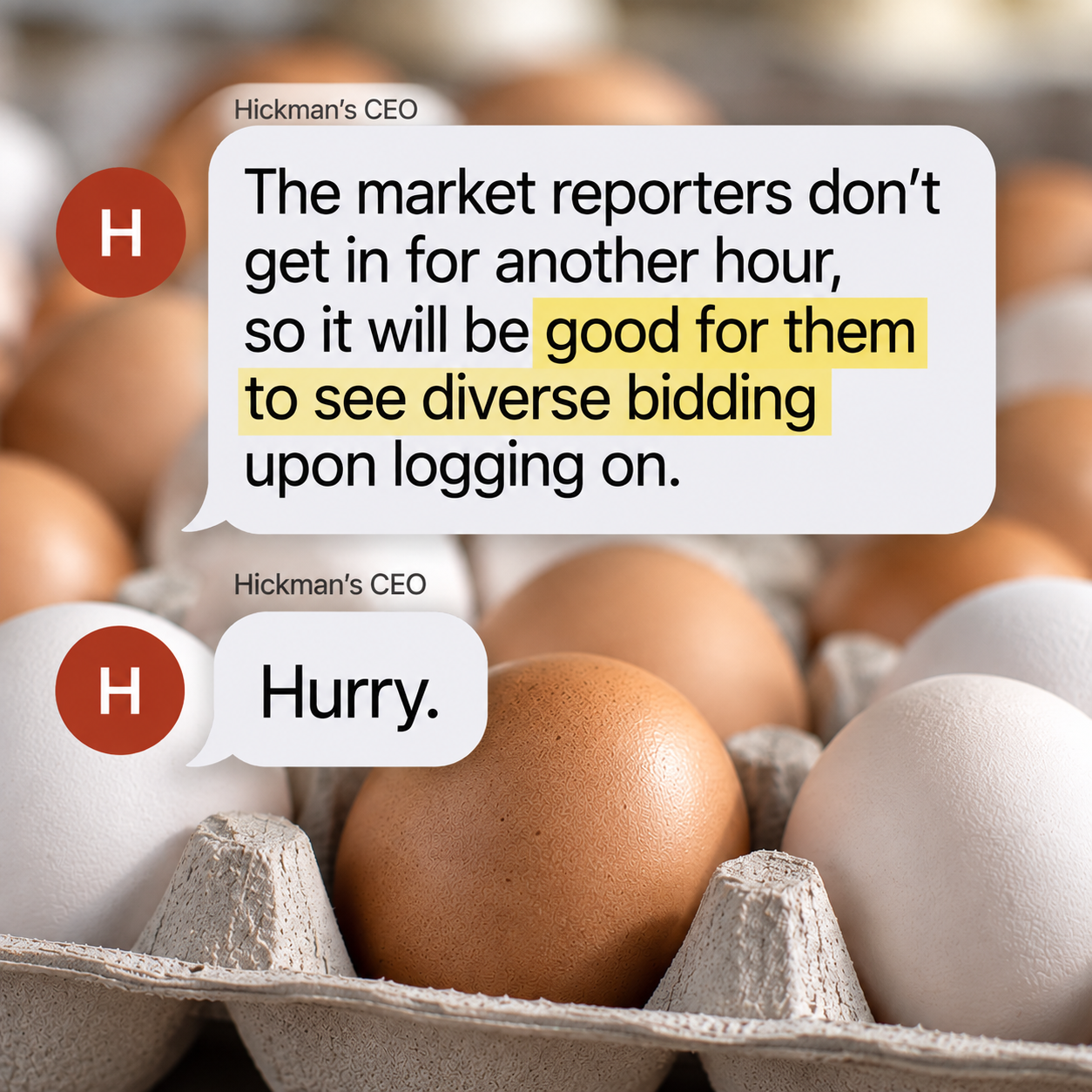
Soon Cal-Maine, Versova, and Hickman’s had placed dozens of bids, most above the current market price, while everyone else combined placed fewer than six. Urner Barry raised its benchmark again.
“Bid like they vote in Chicago”
The next day, Hickman’s CEO told the group that the market reporter was “trying to set the stage” for prices to fall and again encouraged the companies to bid for eggs.
Later, the CEO of another egg cooperative joined in. “As a group we need to bid like they vote in Chicago, early and often,” he wrote.
The following morning, Hickman’s CEO told the group to “bid early and often today.” A senior Versova executive then told another Versova executive to “light up the northwest bids please” and instructed him to bid two cents above the current benchmark.
Soon, sellers tried to take Versova up on those bids. One Versova executive reported that the bids were “getting hit,” meaning sellers were willing to accept Versova’s offers. The other executive told him to delete the bids.
According to the complaint, that suggested Versova did not actually need the eggs. The high bids could make it look like buyers were willing to pay more, but when sellers tried to accept them, Versova pulled the bids.
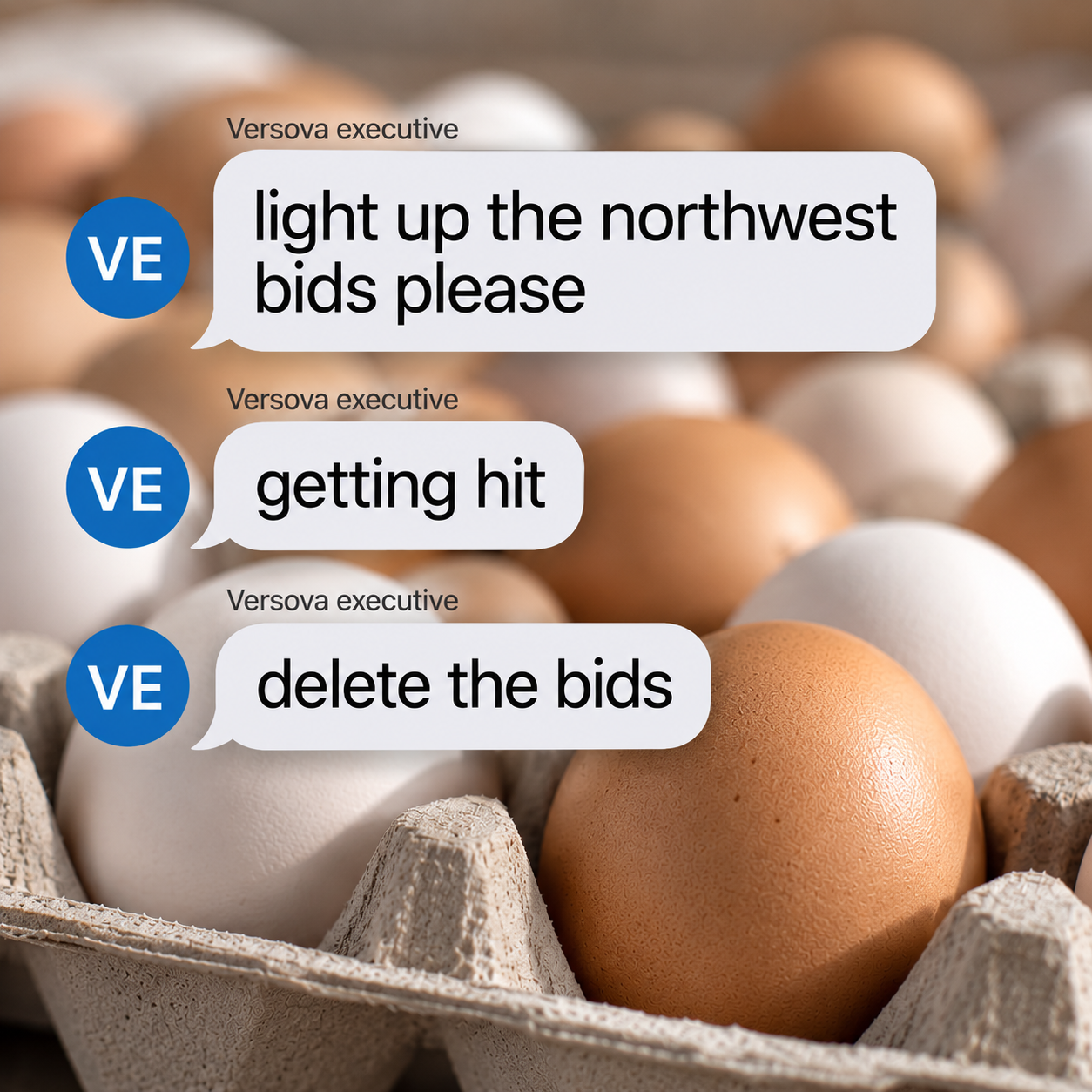
Once again, the three companies placed dozens of bids while everyone else combined placed only five. Urner Barry raised its benchmark again.
Hickman’s CEO then sent the other executives an Urner Barry report saying egg prices were hitting records.
“Great job in the northwest today!”
“Needs premium trades to hang her hat on”
The government says the companies also used actual egg sales to influence the benchmark.
In August 2023, a Cal-Maine executive texted a Versova executive asking if he had more eggs to sell. He added that the Urner Barry market reporter “needs premium trades to hang her hat on.”
“Premium trades” are egg sales made at prices above Urner Barry’s current price. The two companies then made three private deals at those higher prices. Cal-Maine sent the purchase records to Urner Barry, giving its market reporter high-priced sales to use when setting egg prices.
Two days later, Urner Barry raised its benchmark. Then it raised it again the next day, and again the day after that.
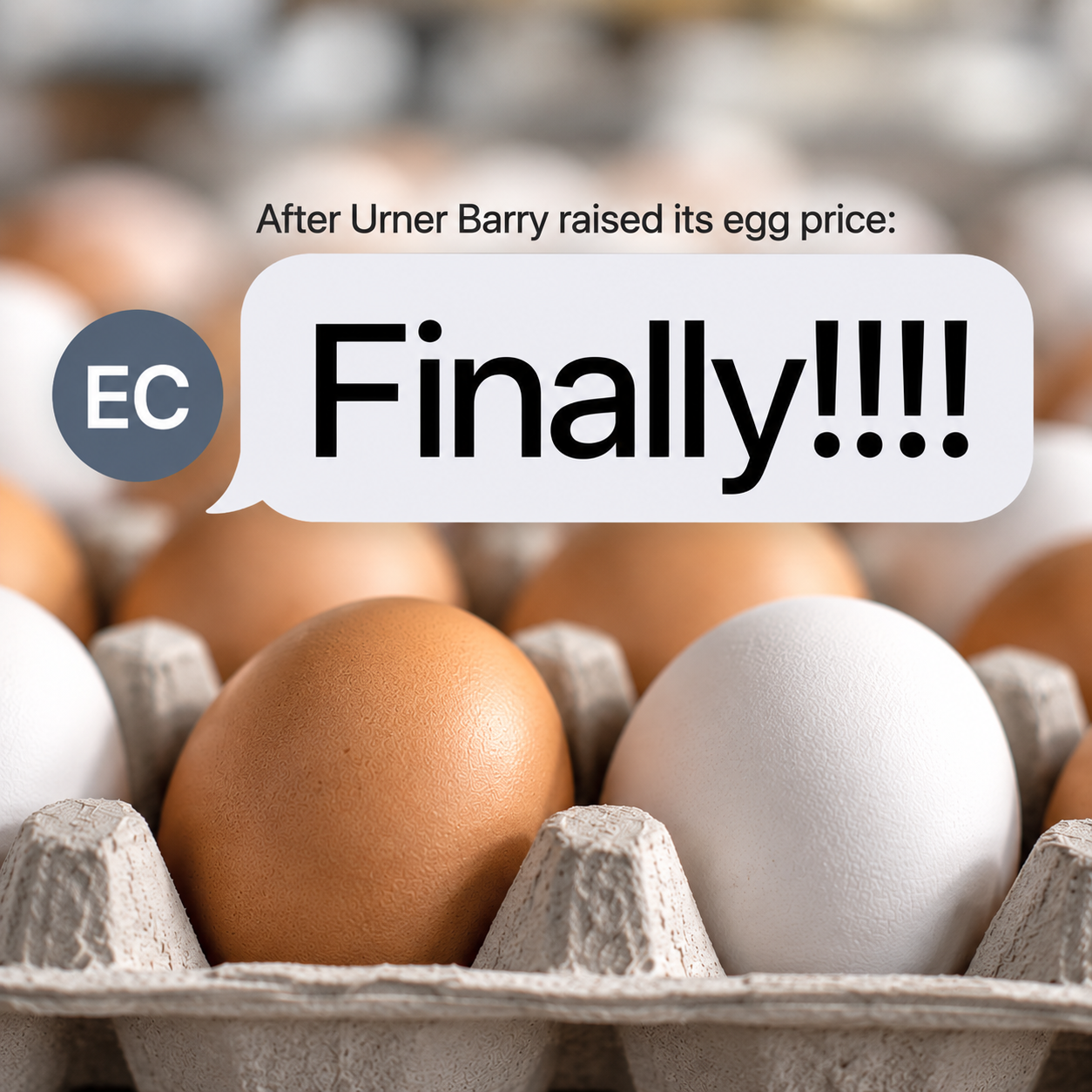
After the first increase, the CEO of another egg cooperative forwarded the new numbers to Cal-Maine with one word:
“Finally!!!!”
“Let it rip”
The alleged coordination continued into another period of soaring egg prices.
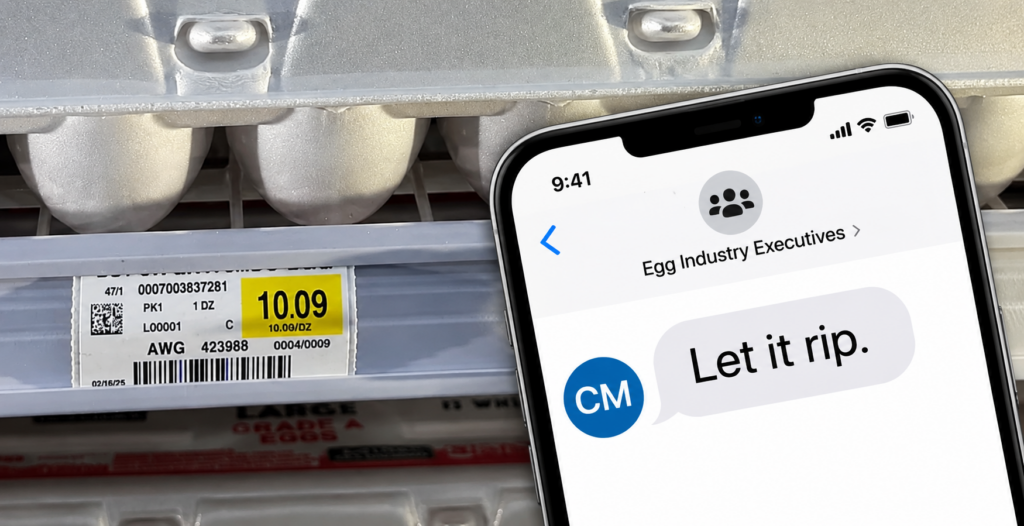
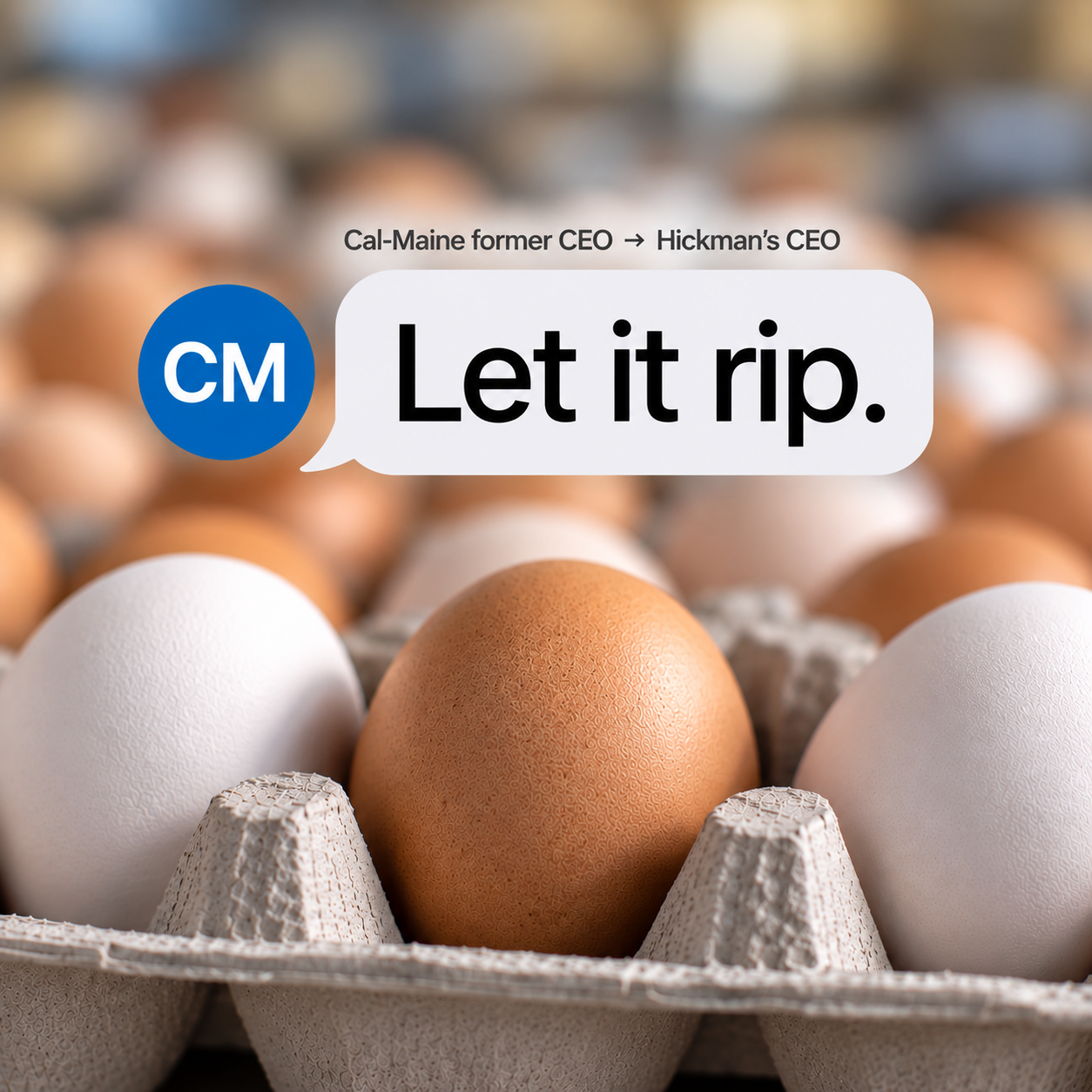
On December 3, 2024, Hickman’s CEO spoke by phone with executives from Cal-Maine and Versova. Early the next morning, Cal-Maine’s former CEO sent Hickman’s CEO a text: “Let it rip.”
After that message, the companies started placing more bids. More of those bids were above Urner Barry’s price, and more went unfilled. The DOJ says the companies also pushed Urner Barry to raise its prices and pay less attention to sales that showed prices should be lower.
By February 2025, egg prices had reached extraordinary levels again. Then, on March 5, the companies learned the Justice Department was investigating and were told to preserve their documents.
The government says Urner Barry’s benchmark “dropped significantly” from its February peak after that.
Farm Action Saw the Warning Signs
Farm Action started raising alarms in January 2023. We looked at egg production, prices, costs, and corporate financial statements and found that the numbers did not add up. The egg-laying flock had declined, but not nearly enough to explain the extraordinary price increases. Meanwhile, Cal-Maine had not reported a single case of avian flu at its facilities and was reporting dramatically higher profits.
We urged federal antitrust enforcers to investigate. Then, after continuing to track the market, we sent a second letter in February 2025 raising fresh concerns about soaring egg prices and restricted supply.
Three weeks later, the DOJ opened an antitrust investigation into the egg industry.
The complaint helps explain what Farm Action saw in the numbers years earlier. Americans were told soaring egg prices were about avian flu and reduced supply. The DOJ now alleges that executives at competing egg companies were working together to push prices higher.
So Where Is the Accountability?
The DOJ’s proposed settlements would require the companies to make payments, donate eggs, create antitrust compliance programs, and allow government monitoring.
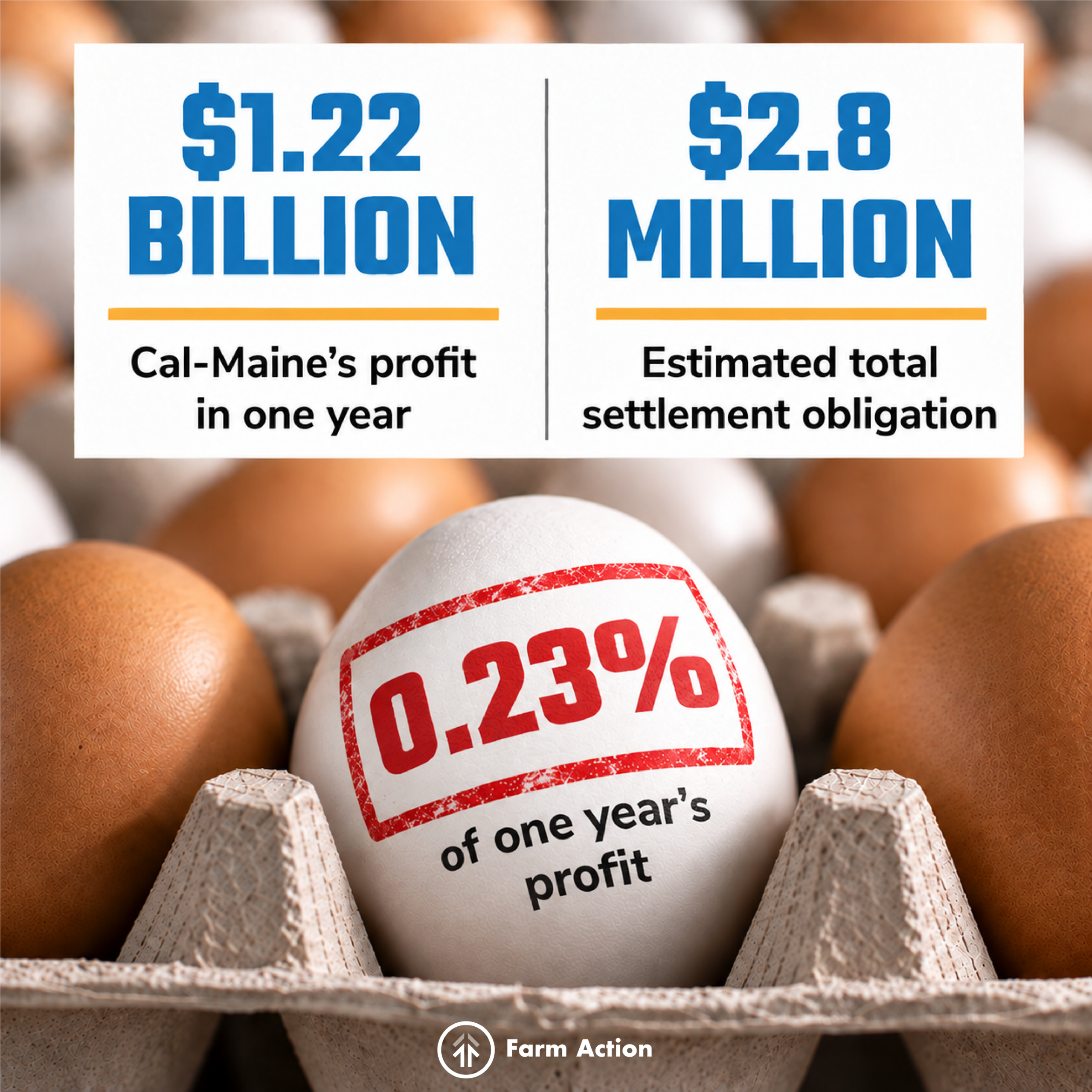
But look at what that means for Cal-Maine, the nation’s largest egg company. Farm Action estimates its total obligation at about $2.8 million. That is roughly 0.23% of the $1.22 billion in profit Cal-Maine reported in fiscal year 2025 alone.
Under this settlement, the companies admit no wrongdoing, there is no trial, and none of the executives whose communications appear throughout the DOJ’s complaint have been criminally charged in this case.
Farm Action is formally opposing the proposed settlements. If allegations this blatant do not bring serious consequences, what will?
If companies can allegedly work together to drive up the price of a basic food and face consequences equal to a tiny fraction of one year’s profit, what will stop the next company from doing the same thing?
Price fixing needs consequences serious enough to deter it.
Before the settlements can take effect, a federal court must review them. The public has until October 17 to weigh in. Fill out the form below to submit your comment.