By Jessica Cusworth
Based on analysis by the Farm Action policy team
A handful of powerful corporations dominate our food system, wielding the resources to shape the rules that govern them.
The Trump administration’s plan to roll back three U.S. Department of Agriculture (USDA) competition rules is the latest example. The rules would have helped protect farmers from abusive monopoly power. Instead, the rollback benefits the largest poultry corporations that have invested millions in campaign contributions, lobbying, and government access.
This move shows how corporate concentration translates into political influence, enabling dominant companies to protect the systems that keep them in control and the scales tipped against farmers.
Market Concentration Creates Political Power
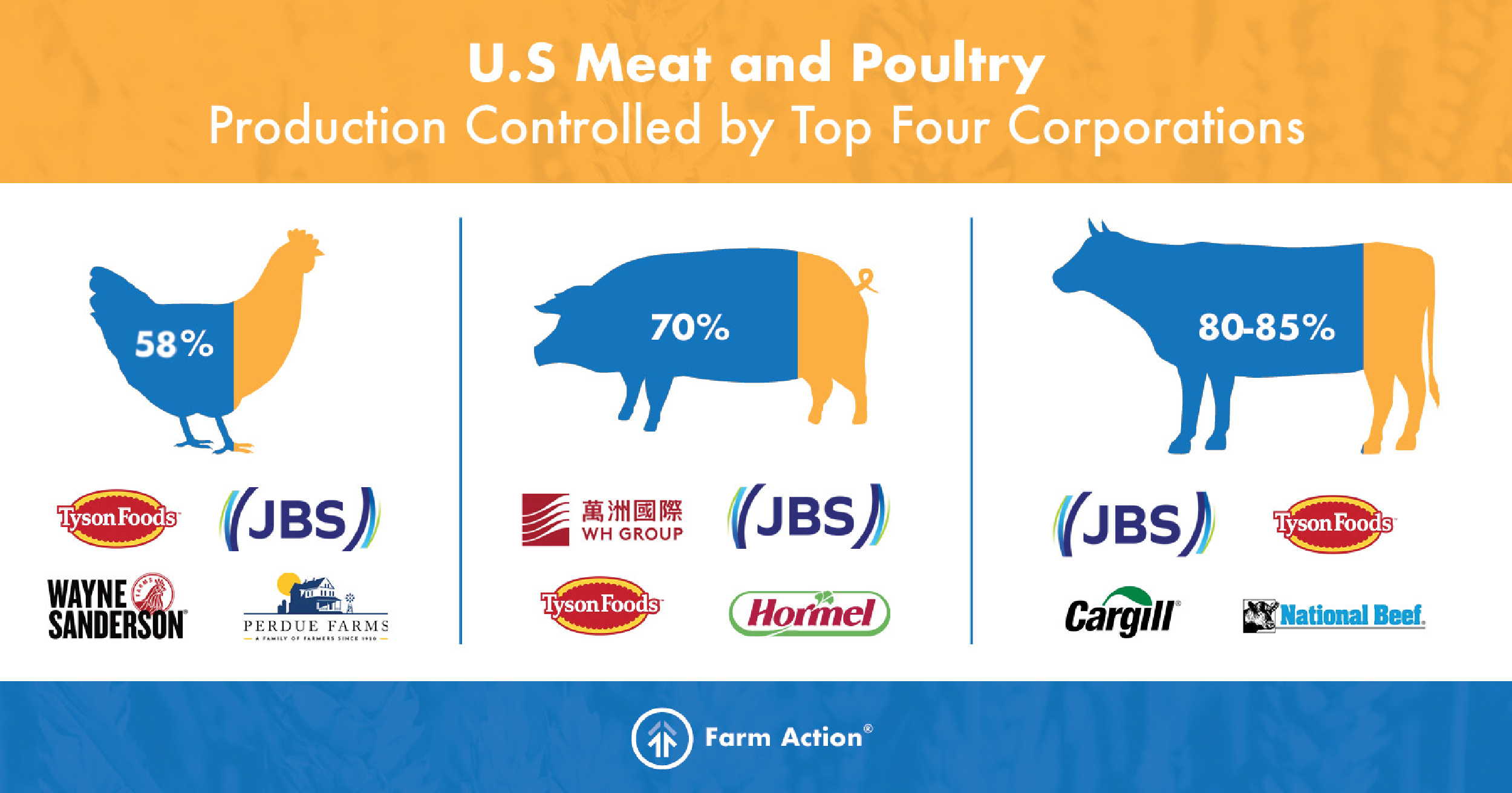
Just four companies—Tyson Foods, Pilgrim’s Pride, Wayne-Sanderson Farms, and Mountaire Farms—control 58% of the poultry industry.
That level of concentration leaves the farmers raising poultry, called poultry growers, with little choice but to contract with the largest companies. Under these contracts, poultry companies control nearly every aspect of production while growers shoulder the financial risk, giving these companies abusive levels of power over farmers’ income and operations.
This power has generated enormous wealth for the industry’s largest corporations, giving them resources far exceeding those available to independent farmers and smaller competitors. Those resources extend beyond the marketplace and into the political arena.
The Rules That Threatened That Power
The three USDA rules now slated for withdrawal or delay would have helped protect growers from harmful practices by the companies that control their operations. They would have required poultry companies to give growers more information about how they are paid, limited their ability to retaliate against farmers who speak up, and barred abusive practices in the tournament payment system.
By rolling back these protections, the Trump administration is preserving a system that continues to favor and empower the largest poultry companies.
How Companies Shape the Political Process
Outsized market power gives dominant companies the resources to shape the political process.
Campaign contributions are one way they exercise that influence. JBS, the majority owner of Pilgrim’s Pride, contributed $5 million to the Trump-Vance Inaugural Committee on January 2, 2025—the largest disclosed contribution to the committee.
Owner and chairman of Mountaire Farms, Ronald Cameron, has also contributed millions to Republican political organizations during the 2025–2026 election cycle, including $2.5 million to the Congressional Leadership Fund, $2.45 million to the Senate Leadership Fund, more than $620,000 each to the Republican National Committee and National Republican Senatorial Committee, and more than $1.2 million to Grow the Majority PAC.
Campaign contributions aren’t the only way these companies influence policymaking. JBS has also maintained an active lobbying operation during the current administration, reporting $450,000 to $530,000 in lobbying expenditures each quarter.
The company has also built a team with deep government experience, including former senior USDA officials and congressional agriculture staff. These connections provide relationships, insider information, and insight into the agencies and lawmakers responsible for shaping agricultural policy.
Although Pilgrim’s Pride does not separately report lobbying activity, disclosures show that it supports and participates in JBS’s lobbying efforts.
Together, these investments give dominant poultry companies a level of access and influence that independent farmers and smaller competitors cannot match.
Why This Matters
The rollback of these USDA competition rules shows why farmer-first reforms are so difficult to achieve in a highly consolidated food system.
While contract growers have spent years advocating for greater transparency, stronger protections against retaliation, and fairer contracting practices, the companies opposing those reforms have far greater resources to shape and preserve the political environment in which those decisions are made.
Until policymakers curb monopoly power, dominant companies will continue to write the rules—leaving independent farmers fighting an uphill battle for a fair shake.