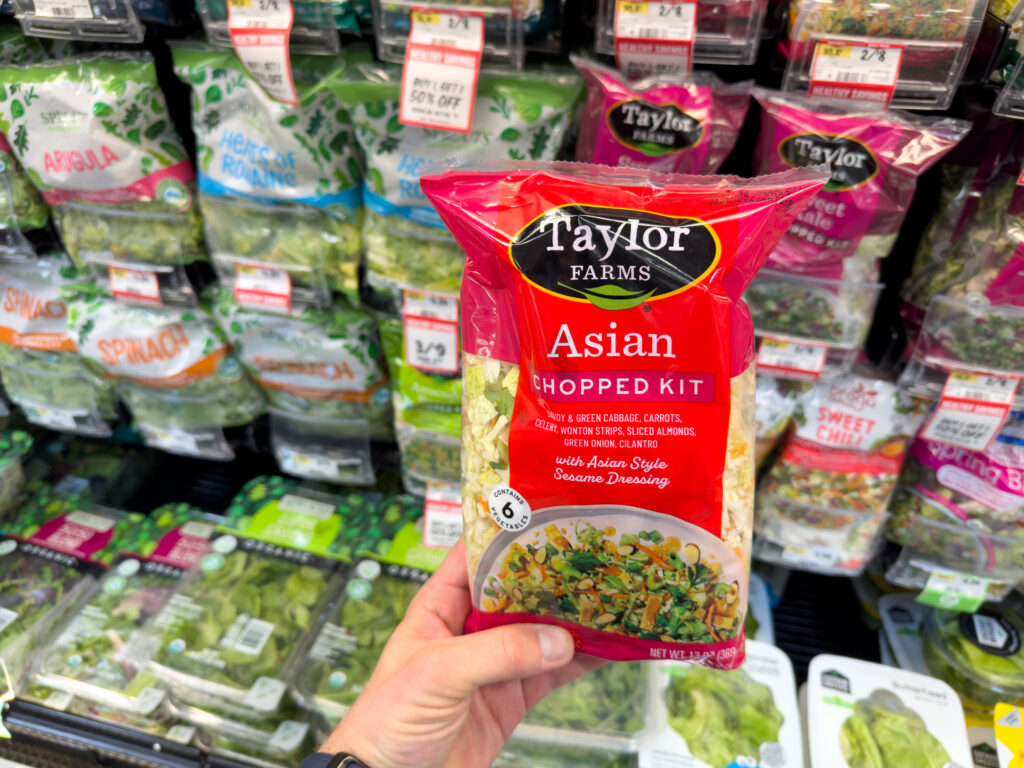
As foodborne illness outbreaks sicken thousands of Americans this summer, a new Farm Action report examines the massive Cyclospora outbreak linked to lettuce supplied by Taylor Farms and what it reveals about the enormous and often hidden power of one of the nation’s largest produce suppliers.
Taylor Farms: How One Company’s Reach Became a National Risk traces how the company became a major gatekeeper between farms and consumers and connects its growth to broader questions about food safety, competition, worker safety, political influence, and government oversight.
The investigation finds that Taylor Farms has grown into a $7 billion company with more than 25,000 employees and 30 processing facilities. It produces more than 265 million servings of fresh food each week and 40% of the salad kits sold in the United States. Its products move through grocery stores, restaurants, distributors, schools, hospitals, hotels, prepared foods, and other brands, meaning millions of consumers may encounter Taylor Farms products without knowing the company behind them.
“People are watching outbreak after outbreak this summer and asking what is going wrong,” said Angela Huffman, president of Farm Action. “Taylor Farms shows the risks when a handful of powerful corporations control so much of how our food gets from farms to consumers. A problem at one company can quickly affect people across the country. We need to rebuild local and regional food networks that support family farmers and give consumers safer food and more choices.”
Among the report’s findings:
- Taylor Farms has been connected to multiple major food safety events, including the 2026 Salmonella outbreak linked to jalapeño products, previous Cyclospora outbreaks, the 2024 E. coli outbreak linked to McDonald’s onions, a 2021 E. coli cluster involving romaine lettuce, and numerous recalls.
- Taylor Farms has paid more than $1 million in penalties for OSHA violations, including violations involving machine hazards, chemical exposure, sanitation failures, amputations, and a fatal workplace incident.
- Taylor Farms has a significant political footprint. The company and CEO Bruce Taylor have donated millions to Republican and Trump Administration-associated PACs since 2025, while Taylor Farms has spent $810,000 on lobbying. On July 16, the same day the Food and Drug Administration (FDA) and the Centers for Disease Control and Prevention (CDC) announced their Cyclospora investigation, company executives met with White House and FDA officials.
- The company’s rise reflects broader consolidation across the food system. As grocery chains, restaurants, distributors, and other buyers consolidated, they increasingly sought fewer, larger suppliers capable of filling national contracts. Today, an estimated 80% to 90% of fresh produce is marketed through grower-shipper-packers such as Taylor Farms.
“When you put these pieces together, you see more than the story of one outbreak,” said Sarah Carden, Farm Action’s Senior Director of Research and Policy. “Taylor Farms has extraordinary reach across the produce supply chain, a history of connections to major food safety events, significant political spending and access, and a workplace record that raises serious questions. Its growth also shows how consolidation has left farmers with fewer buyers and made our food supply increasingly dependent on a small number of powerful companies.”
Farm Action’s report calls for stronger antitrust enforcement, investment in local and regional food infrastructure, reforms to policies that drive consolidation, greater transparency and accountability in government, and stronger food safety and produce traceability.
Alongside the report, Farm Action launched a new petition, Stop the Food Outbreaks. Hold Powerful Corporations Accountable. The petition urges policymakers to strengthen food safety, support family farmers, rebuild local and regional food systems, and increase corporate and government accountability.
Read the full report: Taylor Farms: How One Company’s Reach Became a National Risk
Media Contact: Emma Nicolas, [email protected], 202-450-0094