
A Farm Action report
August 2026
Research and analysis by Sarah Carden, Colleen Fulton, Angela Huffman, and Caroline Nodus
Written by Jessica Cusworth
The 2026 Cyclospora outbreak has sickened thousands of people across the United States and killed at least two. In July, the U.S. Food and Drug Administration (FDA) linked the outbreak to shredded iceberg lettuce served at Taco Bell and supplied by Taylor Farms, a company most Americans had never heard of despite its enormous reach.
Taylor Farms’ products are in grocery stores, restaurants, schools, hospitals, and prepared foods, often under other names. That extensive and often hidden reach raises questions that go far beyond this outbreak. When so much of the food supply runs through a single company, a problem can quickly affect people across the country.
This report examines how Taylor Farms became one of the country’s largest produce suppliers, how far its reach extends, and what that power means for food safety, farmers, workers, and competition. It also looks at the company’s political influence, raises questions about government oversight, and recommends policy changes to strengthen food safety, competition, transparency, and public accountability.
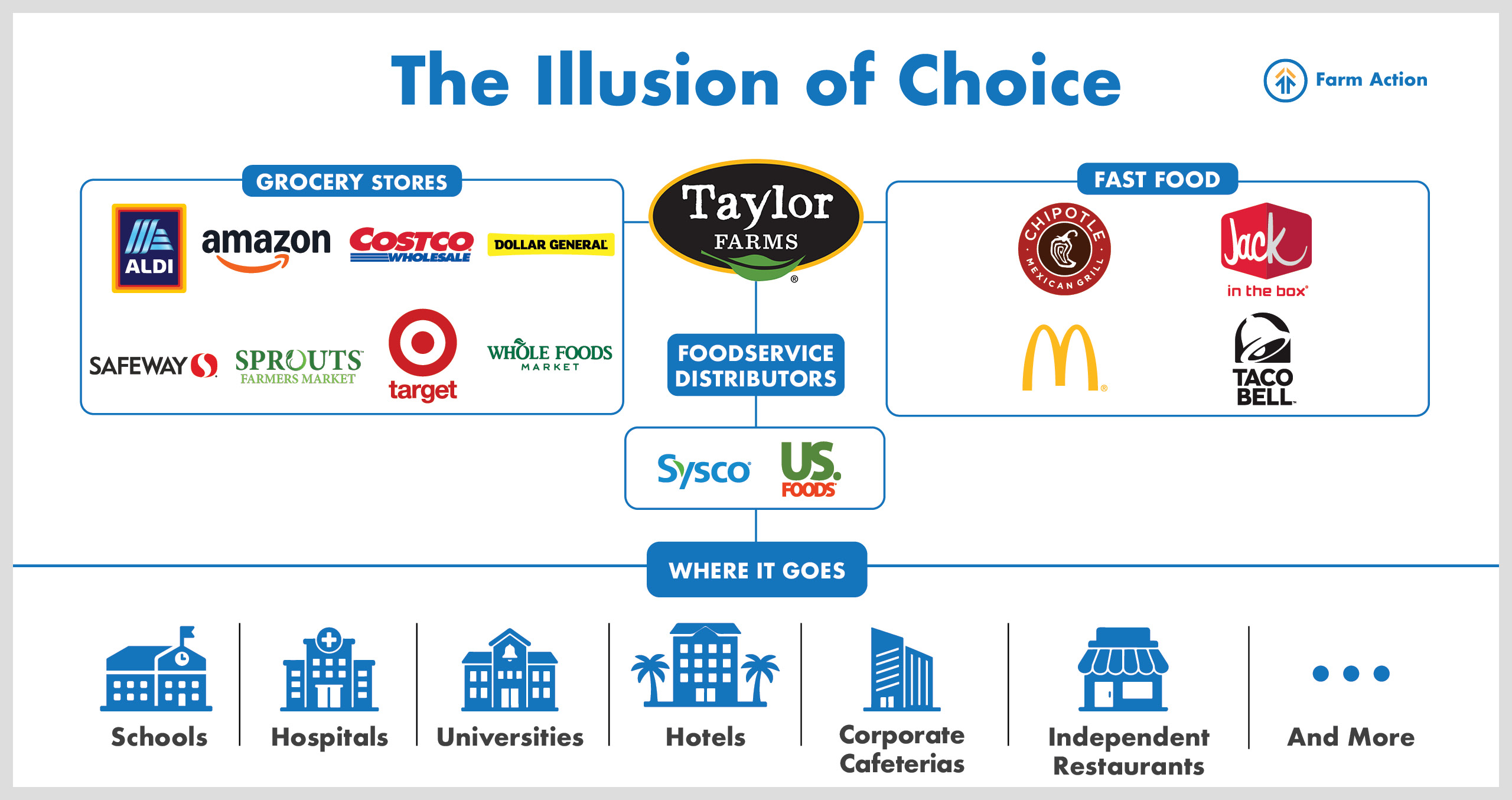
Taylor Farms products are nearly everywhere, often under other brands, making one supplier look like many.
Founded in 1995, Taylor Farms has grown into a $7 billion company with more than 25,000 employees and 30 processing facilities across the U.S., Canada, Mexico, and Europe. It produces more than 265 million servings of fresh food each week, making it one of the largest companies in the U.S. produce system.
Its products extend far beyond its own brand, including salad kits, fresh-cut vegetables, prepared meals, organic products, and more. Taylor Farms produces 40% of the salad kits sold in the country and grows about one-quarter of its own vegetables, sourcing the rest through partner farms. That makes it a major link between farms and some of the nation’s largest food buyers.
Taylor Farms products appear in grocery stores, restaurants, prepared meals, and institutional kitchens, often without the Taylor Farms name attached. Consumers may see many different brands, while much of that food comes from the same supplier.
As a privately held company, Taylor Farms does not publish a full customer list. Public records and recalls have linked its facilities to products sold through retailers like Kroger, Trader Joe’s, H-E-B, Meijer, Albertsons, and Walmart, as well as foodservice distributors like Sysco and US Foods that supply schools, hospitals, hotels, and more.
This means its reach is often hidden from consumers and difficult to track. That invisibility shields its market power from public scrutiny and sows confusion during an outbreak.
Taylor Farms’ rise was shaped by decades of consolidation across agriculture and the food industry, enabled in part by public policies that allowed companies to grow larger and markets to become more concentrated. Grocery chains, restaurant companies, foodservice distributors, processors, and other large buyers have consolidated, leaving fewer and much larger companies buying produce.
Those buyers increasingly wanted fewer, larger suppliers that could provide high volumes of produce year-round, deliver it across the country, meet consistent quality standards, produce private-label products, and handle the work of getting food from farms to stores and restaurants. That favored large grower-shipper-packers (GSPs) that could meet those demands. Today, an estimated 80-90% of fresh produce is marketed through these companies.
Taylor Farms is one of those GSPs. As it grew, the company bought other businesses, built processing facilities, and developed a sourcing network spanning multiple regions and countries. Like other large GSPs, Taylor Farms sources produce through regional and international networks rather than relying primarily on nearby farms. That helps explain why investigators traced lettuce implicated in the 2026 Cyclospora outbreak to Mexico, even in the middle of summer when much of the U.S. is capable of growing lettuce.
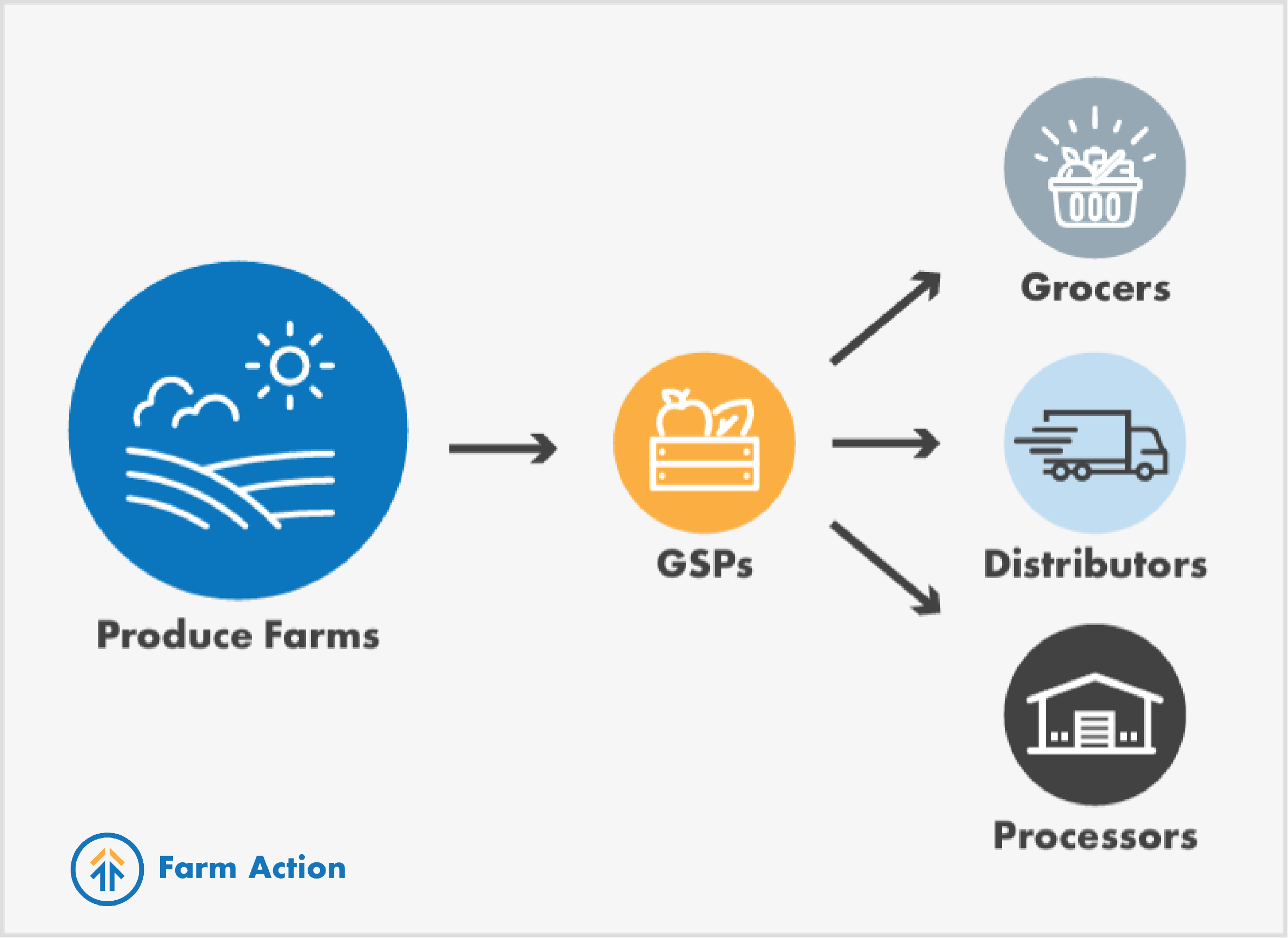
Grower-shipper-packers (GSPs) like Taylor Farms have become key gateways between farms and the companies that sell food across the country.
As Taylor Farms expanded, it became a major link between farms and national grocery stores, restaurants, and foodservice companies. As buyers consolidated and markets became organized around large national contracts, companies that could operate at this scale gained an advantage, giving the largest suppliers more control over how produce moves from farms to consumers.
That concentration of power comes at a cost. The larger a company’s reach, the greater the consequences when something goes wrong.
Those risks are compounded when a company’s reach is largely hidden from public view. Consumers often have no way of knowing when they are eating Taylor Farms products, leaving regulators, researchers, and journalists to piece together the company’s footprint during a food safety investigation.
Taylor Farms has been connected to several major food safety events, including the 2026 Salmonella outbreak linked to jalapeño products, previous Cyclospora outbreaks, the 2024 E. coli outbreak linked to McDonald’s onions, the 2021 E. coli cluster involving romaine lettuce, and numerous recalls for allergens, labeling errors, contamination risks, and processing defects.
These incidents do not by themselves prove a pattern of systemic problems. But Taylor Farms’ repeated connection to major outbreaks and recalls warrants a closer look at whether these are unrelated incidents or signs of recurring weaknesses.
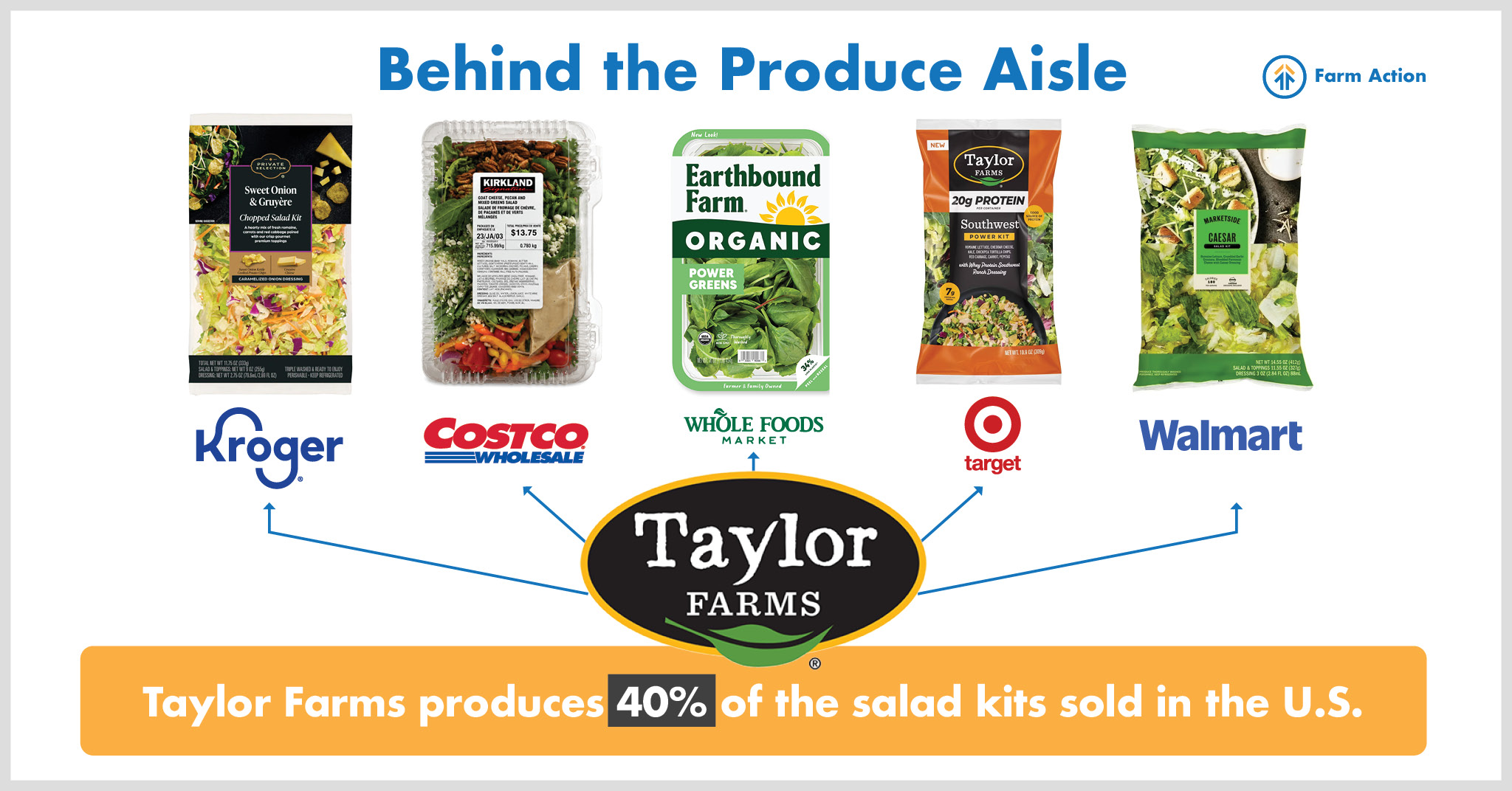
Taylor Farms’ growth has made it a major supplier behind the products lining grocery store shelves.
The same forces that fueled Taylor Farms’ rise reshaped produce markets to the detriment of farmers and smaller competitors.
As the food system consolidated in recent decades, farmers lost many of the independent buyers and markets they once relied on to sell their produce. Instead of selling to many competing buyers, farmers increasingly rely on a smaller number of large GSPs and other buyers to reach the market. This creates higher barriers for independent farmers, regional suppliers, and new competitors trying to access the market.
With fewer buyers to choose from, farmers have less leverage in negotiations over prices and services. Many have little choice but to accept the terms they’re offered. Over time, that shift has contributed to a shrinking number of small and mid-sized produce farms and greater concentration among the largest farms and suppliers.
Taylor Farms’ rise shows how a system built around scale can create powerful gatekeepers between farmers and consumers.
Taylor Farms’ massive operations depend on thousands of workers who process, package, and move its produce. Its workplace safety record includes serious violations and worker complaints.
Taylor Farms has paid more than $1 million in penalties for violations cited by the Occupational Safety and Health Administration, including machine hazards, chemical exposure, electrical hazards, sanitation failures, amputations, and a fatal workplace incident.
Workers and labor organizations have also raised concerns about retaliation, low wages, temporary-worker practices, hazardous conditions, and inhumane treatment. In 2013 and 2014, workers at Taylor Farms’ Tracy, California, facility reported pressure not to use the bathroom during shifts, being denied meal breaks, and being fired after injuries. They also accused the company of retaliating against workers who organized for better pay and working conditions.
These conditions do not establish that Taylor Farms’ labor practices caused the Cyclospora outbreak. However, they do raise broader questions about how a company operating at this scale protects its workers and is held accountable for workplace safety.
Taylor Farms’ power extends beyond the produce market. Its size gives the company financial resources and access that smaller farms and businesses do not have, creating more opportunities to influence the policies and regulations that govern its industry.
Taylor Farms and its CEO, Bruce Taylor, have donated millions to Republican and Trump Administration-associated political action committees (PACs) since 2025. This includes a $1 million contribution to both MAGA Inc. and a super PAC dedicated to electing House Republicans. Taylor Farms has also spent $810,000 on lobbying since 2025.
Taylor Farms also hired a former White House official. And on July 16, the same day the FDA and the Centers for Disease Control and Prevention announced their investigation into the multistate Cyclospora outbreak, Taylor Farms executives met with White House and FDA officials. Administration officials said Taylor Farms sought to distance itself from the outbreak and questioned the government’s conclusions. This meeting shows the level of access Taylor Farms had to federal decision-makers while its interests were directly at stake.
Taylor Farms has another avenue for influence through industry trade associations. Bruce Taylor has held notable positions in the International Fresh Produce Association, the Produce Marketing Association, and Western Growers. Large companies like Taylor Farms have more resources to help shape trade association positions, which can then be presented to regulators and policymakers as the voice of the broader industry.
The FDA’s Food Traceability Rule provides an example. Trade groups connected to Taylor Farms pushed back on aspects of the rule and its implementation before the agency ultimately delayed its compliance deadline.
Political contributions and lobbying do not prove that government decisions were influenced by Taylor Farms. However, when a company holds a major position in the food supply, its financial resources and political access can give it a stronger voice in shaping the rules that govern its industry.
That imbalance raises a broader concern that the companies with the most market power also have the greatest ability to influence the policies meant to hold them accountable.
The problems documented in this report stem in part from policies that have allowed a small number of companies to gain enormous power over how our food is produced, sold, and distributed. Our policy recommendations would restore competition, give farmers more ways to reach the market, strengthen food safety and traceability, and hold powerful companies and government decision-makers accountable.
Farmers have fewer buyers to choose from, while large produce companies have gained more control over how food moves from farms to consumers.
Heavy reliance on large national suppliers can make communities more vulnerable when one supplier has a problem.
Federal policies currently reinforce the growth of the largest farms and suppliers instead of helping maintain a diverse farm economy.
Powerful companies have greater access to the government officials and institutions responsible for overseeing their industries. Greater transparency and stronger safeguards are needed to ensure that public decisions serve the public interest.
Consolidation has created sprawling supply chains that can make it harder to trace contaminated food back to its source, especially when products move through multiple companies and brands.
Building a more competitive and resilient produce market will require policy change, but consumers and communities can also support alternatives to the dominant national supply chains.
Taylor Farms didn’t become one of the nation’s largest produce suppliers just because consumers preferred its brand. It grew as grocery chains, restaurant companies, distributors, and other buyers consolidated and increasingly demanded suppliers that could provide large volumes year-round, serve customers across the country, and produce food under other brands.
The Cyclospora outbreak put the spotlight on Taylor Farms, but the questions raised by this report go beyond one company or one outbreak. Taylor Farms’ reach shows what can happen when a small number of companies gain enormous power over how food is sourced, processed, and sold, while much of that power remains hidden from the public.
A more resilient produce system requires more than better practices from the largest companies. It requires more competition, more ways for farmers to reach the market, stronger oversight, greater transparency, and policies that stop rewarding consolidation.